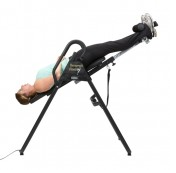
Showing posts with label Invert table. Show all posts

Tuesday, April 8, 2014

How long should one invert and in what angle?

20 degree inversion
How long should I invert? In what angle should I invert? These are probably the most obvious and the most practical and important questions. Answers to both these questions are inter-related, and hence I will deal with them together.

To start with, beginners should invert at slight angles, and only for short durations. For example, start with mild angles of 20-30 degrees for the first few weeks, for 10-20 minutes once or twice a day. Stick to this until you are comfortable with the operation of the table, and feel totally at ease while inverted. Even while inverting at 20-30 degrees, the benefits of inversion start taking effect. The body experiences mild stretching, circulation is stimulated, and oxygen flow to the head improves.

Once you get comfortable with the beginner’s position, and are ready to move beyond it, you may want to proceed by increasing the angle to 45 degrees, and then to 60 degrees. Remember that the shallower the angle of inversion, the longer you can remain inverted. So, as you start increasing your angle of inversion, reduce the time you remain inverted, and slowly increase this time, until you get comfortable at that angle for prolonged inversion. There is no set time limit, and the important thing is that you listen to your body, and not ignore any sign of discomfort.

60 degree inversion
90 degree inversion

60 degrees is the angle at which the body starts getting full benefits of inversion. The spine receives the traction it needs to decompress at this angle. In fact, 60 degrees is optimum for most people, and you might not really need to go beyond this.

Thursday, January 30, 2014

Choose the right equipment for Inversion Therapy

Ironman Gravity Inversion Table
Gravity Inversion Table
A gravity inversion table is a health equipment that is designed for those who seek higher levels of physical wellness. Gravity inversion has also been shown to be effective in relieving body pains, especially back pain. Inversion tables allow a person to hang upside down, or at an angle, against the direction of gravity. It is believed that gravity compresses the discs in the spine, thereby leading to reduced lubrication between discs (just like squeezing out a sponge). This leads to increased friction between the spinal discs, leading to back pain. Decreased lubrication also causes the chances of nerves getting pinched, spinal misalignment, and reduced flexibility. Inversion therapy helps in reversing this effect of gravity. By hanging upside down, the pressure on the spine is released, and the distance between the vertebrae is increased. This relaxes your spinal area, and relieves back pain. Even if you do not experience back pain, inversion therapy can help you stay fitter and more flexible. Inversion therapy is also known to improve blood circulation.

There are many types of inversion tables available that you can use for your inversion therapy sessions. Below is a list of the various types that you can choose from.

1.         Manual gravity inversion table
These are the conventional inversion tables that have a comfortable backrest as well as ankle holders to hold you securely while inverting. You need to first adjust the table according to your height, adjust the angle of inversion, secure your feet onto the table using straps, and move to the inverted position by pushing the backrest. These tables require you to always keep your arms above your head, to maintain the incline.

2.         Motorized inversion table
Motorized inversion tables have push-button controls for rotating the table. These tables are quite sophisticated, with some interesting engineering innovations. The tables have interlocking gears to hold the table at any angle of your choice. The inversion with the motor is slow and smooth. What’s more, when using motorized inversion tables, you do not need to keep your arms above your head at all times. Just lay down on the table, secure your legs, and push the button. The table does the rest. These tables are more expensive and range from $1.600 - $2.200.

The most recent advancement to inversion tables has been the integration of infrared therapy with inversion therapy. In such tables, the backrest has built-in carbon fiber Far InfraRed (FIR) heating elements to help soothe your back as you are inverting. This advancement combines the benefits of inversion therapy with infrared therapy that is known for its de-stressing, healing and relaxing properties.

4.         Doorway inversion
Doorway inversion systems include an inversion rack and gravity boots. The inversion rack mounts onto your door frame and the gravity boots allow you to hang free from the door frame for maximum range of motion. These systems are meant for fit and flexible users, and the inversion can be a bit difficult to perform.


Inversion therapy is proven to be healthy and is available for everyone. Depending on your level of comfort and your budget, there are many options to choose from. Start your healthy regime today!

Thursday, January 9, 2014

The Inversion Therapy Table – An Easy Way to a Better Life

Inversion Therapy Table
Inversion therapy is a treatment method that involves hanging upside down or at an angle to reverse the effect of gravity, such that blood and lymphs which get pooled at various points of the body are released and moved into the core for oxygenation, filtration, and elimination of cellular metabolic wastes. In other words, inversion therapy helps in purging the body and improving blood circulation throughout the body. Inversion therapy has also been shown to relieve pressure on the spine and lower back, and is finding increasing use in relieving back pain.

Now, the obvious question is, how does one “hang upside down or at an angle”? Well, doing this is not as tough as it may sound. With today’s technology, it is possible to safely and comfortably invert your body to use nature’s force to relieve pain. The inversion table is a piece of equipment that is designed to help you safely invert your body, without any expert assistance, and use your own body weight to move tension off your lower back, and improve blood circulation. The modern inversion therapy table also allows you to control the angle of inversion, so that you can adjust the angle that is the best for you. These tables also come with a locking mechanism to lock the table position at an angle you want.

The most recent advancement in the field of inversion therapy has been the integration of infrared heating technology to inversion tables. Infrared light has the ability to ionize water, thereby leading to enhanced cell metabolism, cellular nutrition uptake, and excretion of residues. By promoting cell growth, infrared therapy provides health and beauty benefits such as reduced fine lines, wrinkles, improved healing of scars, wounds, cuts, and also smoothened skin texture, lessened coarseness, and reduced pore size. Infrared is also known to improve blood circulation. Thus, combining inversion therapy with infrared heating provides an excellent therapeutic as well relaxing effect. 

Using an inversion therapy table: this is as simple as using a treadmill. Each inversion table will have its own set of features and can slightly differ in the way they need to be used. The main steps are: adjusting the table to your height, setting the preferred angle of inversion, securing your feet onto the table using straps (or some other mechanism that comes with the inversion table), and then moving to the inverted position up to the extent you want. Relax and enjoy! You can stay in the inverted position for a few minutes. The therapy can be repeated 2-3 times a day, and please be careful not to overdo it. Hold the inversion only for as long as you feel comfortable, and repeat the inversion only as many times as you feel comfortable.  If you are not comfortable, muscles will get tense and the treatment will no longer be effective.

We recommend to consult a doctor before starting inversion therapy. Please do not use an inversion therapy table if you suffer from osteoporosis, glaucoma, heart disease or high blood pressure, or if you are pregnant.